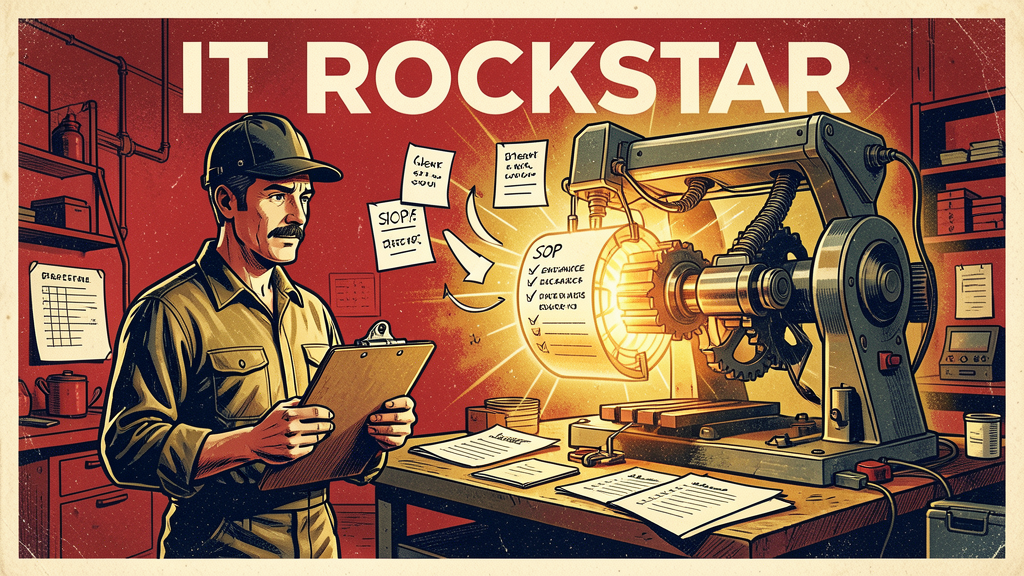
# Turn Your LLM Into an SOP Factory, Not a Fortune Cookie
A lot of people use LLMs like a magic eight ball. They ask vague questions, get vague answers, then decide AI is overrated.
That is the wrong use case.
One of the most practical ways to use an LLM is to turn messy human know-how into clear operating procedures. Every organization has someone who “just knows how that works.” That knowledge is valuable, fragile, and usually trapped in someone’s head, inbox, or half-finished notes.
An LLM can help convert that chaos into SOPs your team can actually use.
## The practical use case
Instead of asking AI to invent a process, give it raw material:
– call transcripts
– screen recordings
– bullet notes
– ticket history
– email threads
– meeting notes
– screenshots described in text
– existing partial documentation
Then instruct it to produce a structured SOP with steps, owners, systems, exceptions, risks, and quality checks.
That is not futuristic. That is Tuesday afternoon productivity.
## The SOP factory prompt structure
Use a consistent prompt. Something like this:
> You are helping document an internal business process. Use only the information provided. Create a practical SOP with purpose, scope, prerequisites, step-by-step instructions, decision points, exceptions, quality checks, and escalation rules. Flag any missing information as questions for the process owner. Do not invent system access, policies, or approvals.
That last sentence matters. “Do not invent” is not decoration. It is how you keep the model from filling gaps with confident nonsense.
## The best workflow
A strong AI-assisted SOP process has four stages:
1. **Capture:** Record or summarize how the work is currently done.
2. **Structure:** Let the LLM organize the raw information into a standard SOP format.
3. **Review:** Have the process owner correct gaps, risks, and exceptions.
4. **Publish:** Store the final SOP in a shared knowledge base with ownership and review dates.
This creates momentum without sacrificing accuracy.
## What to include in every AI-assisted SOP
Do not settle for a numbered list. A useful SOP should include:
– Purpose
– Trigger
– Systems used
– Required access
– Inputs
– Step-by-step procedure
– Decision points
– Common errors
– Escalation path
– Completion criteria
– Related templates or links
– Last reviewed date
– Process owner
That format makes the output easier to train, audit, delegate, and automate later.
## The hidden benefit
Once your SOPs are clean, you can use them as fuel for other AI work.
Clean SOPs can become:
– onboarding guides
– training checklists
– chatbot knowledge bases
– workflow automation specs
– QA scripts
– role-based task lists
– vendor handoff documentation
In other words, documentation stops being a dusty compliance artifact and becomes operational infrastructure.
## The human still matters
AI can organize the procedure. It should not be the final authority. The process owner must validate the steps, especially where money, privacy, security, compliance, or customer commitments are involved.
The right relationship is simple: AI drafts, humans verify, the organization improves.
## Start with one painful process
Pick one process people complain about. Maybe onboarding a new employee. Maybe closing a support ticket. Maybe preparing a monthly report. Maybe handling a new lead.
Record the process. Feed the transcript and notes to the LLM. Generate the SOP. Review it. Publish it. Repeat.
That is how you build a practical AI habit: one useful factory line at a time.
Ralph Perez’s book *Fear Less, Live More* includes other practical ways to use AI with more clarity, confidence, and momentum.
Learn more here: https://www.amazon.com/Fear-Less-Live-More-Practical/dp/B0GGBWHFN2/
Keep building practical AI confidence
Fear Less, Live More
Ralph Perez’s book includes additional practical ways to use AI with more clarity, confidence, and momentum.