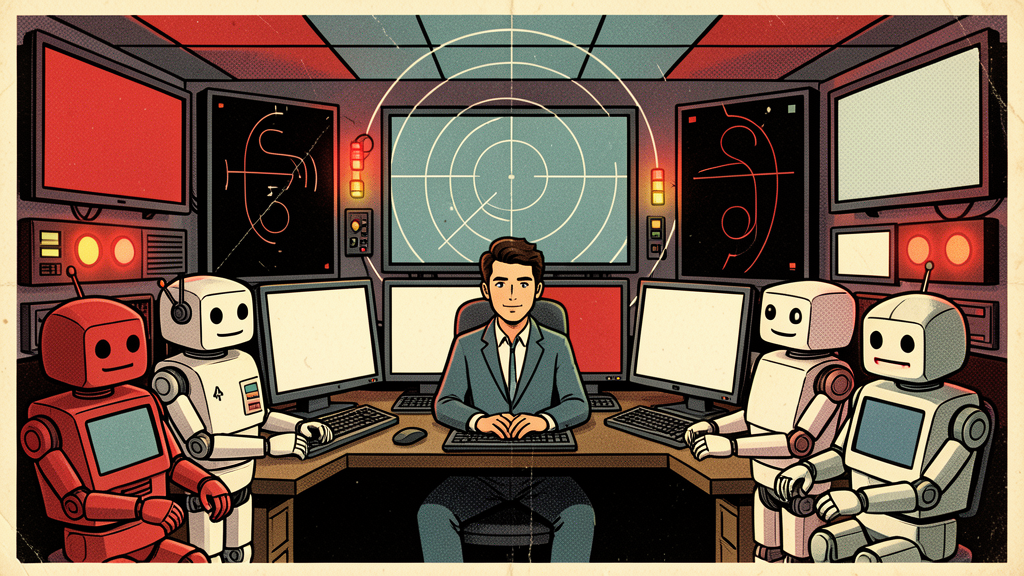
# Give AI Agents a Control Room, Not a Blank Check
AI agents are being sold like tireless digital employees. That sounds exciting until you imagine one enthusiastically sending vendor emails, changing records, closing tickets, and updating dashboards with the judgment of a caffeinated intern on launch day.
The practical answer is not to avoid AI agents. The practical answer is to give them a control room.
A control room is a supervised operating model where agents can gather information, draft actions, prepare recommendations, and execute low-risk tasks within clear limits. Humans stay in command. The agent does the repetitive work. Everybody keeps their badge.
## Start with bounded missions
Do not begin with, run my department. Begin with specific missions:
– Review new tickets and suggest category, urgency, and owner
– Draft vendor follow-up emails based on open action items
– Check dashboards each morning and flag unusual movement
– Compare a purchase request against a standard checklist
– Prepare weekly project status summaries from notes and tasks
– Identify records missing required fields
These are strong agent jobs because they have inputs, rules, outputs, and a review step.
## Build the control room components
A safe agent workflow needs more than a prompt. It needs operational rails:
1. Intake queue: where work enters the agent’s lane
2. Permission boundary: what systems and fields the agent can read or update
3. Draft output: what the agent prepares before action
4. Approval queue: where a human reviews higher-risk work
5. Execution log: what happened, when, and why
6. Exception path: where uncertain items go instead of being guessed
7. Performance review: whether the agent is actually helping
If that sounds like normal operations, good. AI does not eliminate operations. It makes good operations more powerful.
## Use confidence thresholds
Agents should not treat every answer as equal. A ticket classification with high confidence can be tagged automatically. A vendor email involving contract terms should be drafted for review. A security-related alert should be escalated, not improvised.
A simple rule works well:
– Low risk plus high confidence: allow automated action
– Medium risk or medium confidence: require approval
– High risk or low confidence: escalate to a human
This keeps the agent useful without turning it into a liability cannon.
## Keep humans in the loop where judgment matters
The goal is not to make people click approve all day. The goal is to reserve human attention for judgment, tone, risk, exceptions, and relationships.
Let the agent assemble the context. Let it draft the response. Let it check the checklist. But keep people involved when the decision affects money, access, policy, reputation, customer experience, or staff trust.
## Measure boring wins
The best AI agent metrics are practical:
– Minutes saved per workflow
– Tickets routed correctly
– Drafts accepted with minimal edits
– Missed follow-ups reduced
– Exceptions escalated appropriately
– Errors caught before execution
If the agent cannot show those wins, pause and redesign. Novelty is not ROI.
## The IT Rockstar rule
Treat agents like junior operators with excellent stamina, inconsistent instincts, and no political awareness. Give them checklists, boundaries, supervision, and a clean escalation path. They will be far more useful.
That is the difference between practical AI and theater. Practical AI gets work ready, reduces friction, and gives people more room to think. Theater makes a demo video and leaves operations to clean up the confetti.
Ralph Perez’s Fear Less, Live More reinforces the same practical mindset: use AI to build confidence, not chaos, and keep looking for simple ways to turn tools into momentum.
Book: https://www.amazon.com/Fear-Less-Live-More-Practical/dp/B0GGBWHFN2/
Keep building practical AI confidence
Fear Less, Live More
Ralph Perez’s book includes additional practical ways to use AI with more clarity, confidence, and momentum.